

By Sean Hyson — Fitness Coach & Korrect Contributor
View our full workout video on YouTube here
Key Takeaways
– Dumbbells are beneficial for shoulder training because they offer greater range of motion and freedom of motion than barbell training
– Shoulder training must include all three heads of the deltoid muscle as well as attention to the rotator cuff and serratus anterior
– Workouts listed here include routines for beginners, building muscle, and rehabbing shoulder injuries/preventing future ones
– Supplements can help with dumbbell shoulder training. Consider protein powders, creatine, and hydration and pre-workout formulas.
The Best Dumbbell Shoulder Workouts and Exercises for Strong, Healthy Shoulders
If you want big, strong, shoulder muscles that broaden your torso and make your waist look small, there are plenty of “best shoulder workouts” articles on the Web to show you how to build them (even if all you have is a few pairs of dumbbells/kettlebells). Then be sure to look up the articles on how to fix shoulder injuries, which you’ll almost certainly need after hacking away at the most unstable joints in your body with heavy weights for several weeks.
Or, you could stay right here and get a comprehensive guide to shoulder training with dumbbells that builds muscle, strength, and power without wreaking havoc on your shoulders and causing pain and injury that’s hard to come back from.
We get it: you want shoulders that look good but can also perform, and you don’t want to get hurt in the process. This is the Korrect approach to training the shoulders with dumbbells.
Why Use Dumbbells To Train The Shoulders?
The benefits of shoulder workouts with dumbbells come down to convenience, safety, and a unique training effect. For one thing, dumbbells are versatile. You can get a few pairs, or an adjustable set (one example is “selectorized” dumbbells, like Powerblock sells) with a relatively small investment. A few pairs of kettlebells can work too.
You can’t train as heavy with dumbbells/kettlebells as you can barbells, but for shoulder workouts, you don’t really have to. The shoulders assist with chest pressing and back exercises, so they get a lot of stimulus from those movements. Some basic shoulder exercises done with moderate loads are enough to stimulate gains. You’ll never have to worry about getting stuck under dumbbells like you do with a heavy barbell. If something goes wrong during your set, it’s not difficult to control the weight back to a safe position, or just drop it outright.
One big advantage that dumbbells and kettlebells have over barbells is range of motion. You can take your shoulders into a deeper stretch and a fuller contraction with individual, handheld weights than you can with a bar. They also let you train one shoulder at a time, which is good for targeting a weak side and fixing an imbalance.
There’s also greater freedom of motion with dumbbells. With a barbell, your hands are fixed with palms facing forward on any press you do. Dumbbells allow you to press with your palms facing in or at an angle, so you can move in whatever way feels comfortable. And you’re not limited to presses either. Dumbbell shoulder training can consist of lateral raises done at a variety of angles, giving you access to all the different sections of the shoulder muscles that no one exercise can cover (science shows there may be at least seven subsections of the deltoid muscles)1.
What Are the Shoulder Muscles?
When people talk about shoulder muscles, they’re usually referring to the deltoids—sections of the muscles that cover the shoulder joints and raise the arms up in different directions.
Anterior Deltoid
The portion of the muscle on the front of the shoulder. It starts at the collarbone and reaches down to the front of the humerus (upper-arm bone).
Lateral Deltoid
The side of the shoulder. It originates at the top of the shoulder blade and attaches to the outer side of the humerus.
Posterior Deltoid
The back of the shoulder. The posterior delt goes from the back of the shoulder blade down to the back of the arm.
It’s also worth your time to understand two other areas of muscle that greatly influence how the shoulders work. One is the rotator cuff, a collection of four muscles (the infraspinatus, subscapularis, supraspinatus, and teres minor, if anyone quizzes you) that allow your shoulders to twist in different directions. The cuff also helps to hold the humerus in place and keep the joints in the area stable—which is no small feat because, as mentioned above, the shoulders are inherently UN-stable. This is a side effect of having extensive range of motion.
The other muscle you want to pay attention to is the serratus anterior. You can see it peaking out from under your armpit and the side of your ribs if you’re pretty lean (it sort of looks like fingers hugging your chest), and it moves your shoulder blades forward and rotates them upward.
You don’t need to know all the scientific details, but understand that including some direct training for the rotator cuff and serratus will help keep your shoulder joints safe and functioning at their best, while failing to do so can set you up for injury. Most people ignore these muscles and pay the price down the line.
How To Choose The Right Dumbbell for Shoulder Workouts
The amount of weight you use for your shoulder exercises depends on the exercise and the goal, but most of the time you’ll need to choose a weight that allows you at least one or two reps more than the number your set calls for. This will make your sets challenging enough to produce results but not so intense that you strain, break from, and risk injury.
In other words, if your workout says to do 3 sets of 10 reps, you should pick a weight that you’re pretty sure you can do 11 or 12 reps with on the first set, but then you’ll only perform 10. You’ll have to use your best judgment and estimate this.
Once you’ve done that first set, you can make adjustments for the remaining sets. If you feel you went too heavy (maybe you could barely get 10 reps), then you can reduce the load by 10 or more pounds before you do your second set. If, however, the first set was too light, and you did 10 reps but feel you could have gotten more like 13, add a few pounds before your next set.
Beginner Shoulder Workout Routine
If you’re new to weight training, or isolated shoulder workouts, you won’t need much work to see gains. Two or three sets for the three different deltoid heads will do it. Andrew Coates, a personal trainer and fitness writer (follow him on Instagram at @andrewcoatesfitness) offers the following routine, and two ways to do it, according to your preference.
Option A. Perform one warmup set of each exercise in the order shown for 10–12 reps with a light weight. The weight you use should allow you at least 5 reps more than you’re capable of for 10–12, but stay in that rep range. Rest as needed, and then perform two work sets of 8–12 reps, keeping one or two reps in reserve on each set. Rest 1–2 minutes between sets.
Option B. If you want to save time, you can perform the exercises as a giant set, where you do all three movements in succession and then rest 2–3 minutes. Do 10–15 reps for each exercise in turn. Repeat for 2–3 total giant sets.
1. Dumbbell Lateral Raise
Target: lateral deltoids
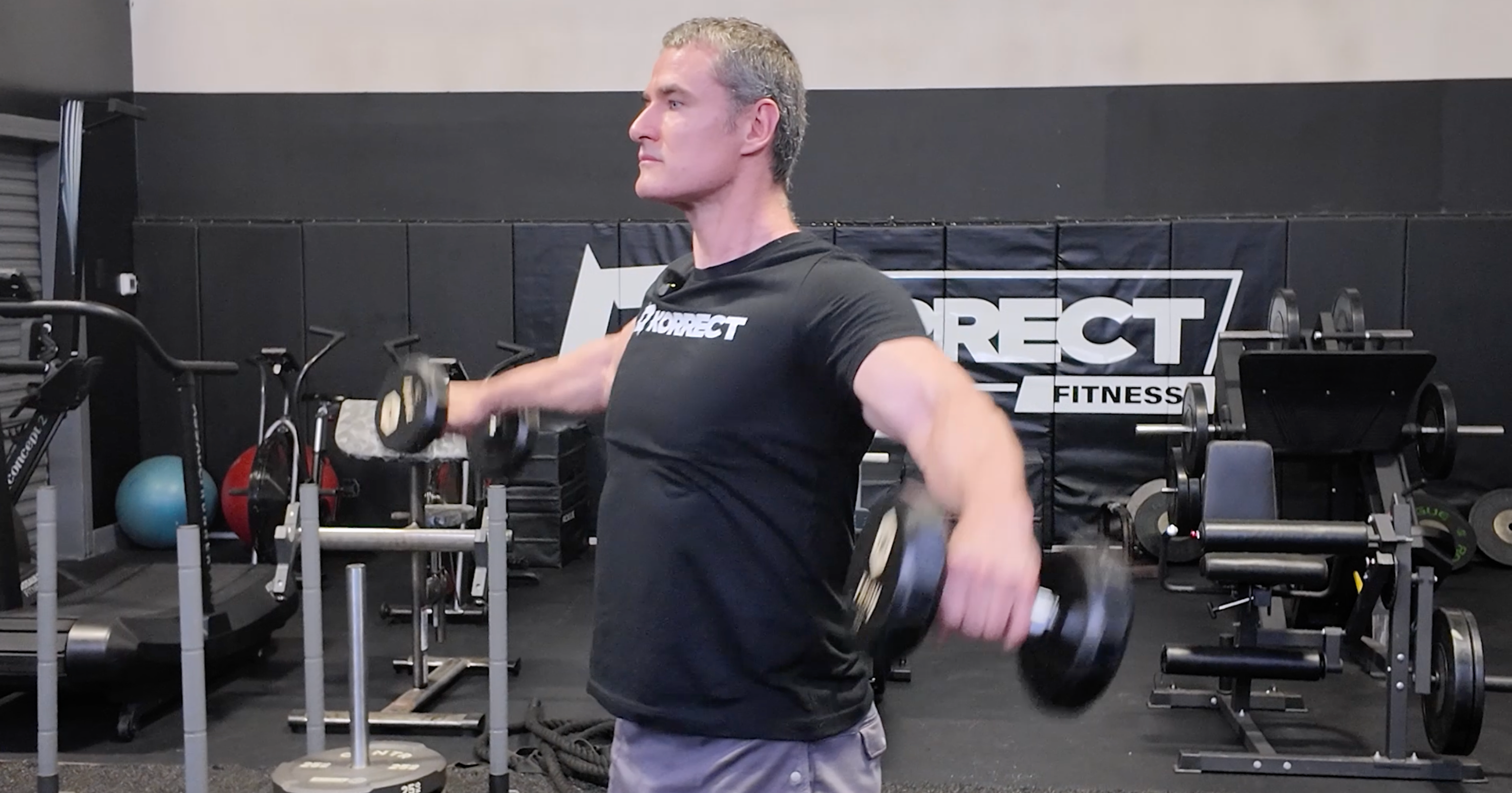
“This is a classic move and it’s essential for building wide shoulders,” says Coates. “Raising dumbbells directly out from your sides may pinch or irritate some shoulders, so a quick fix is to rotate your elbows forward a little to roughly 60 to 75 degrees from the midline of your sternum.”
Step 1. Stand with a dumbbell in each hand. Your feet can be shoulder-width apart and in line with each other, or you can stagger your stance (one foot in front of the other) for greater balance.
Step 2. Raise your arms out to your sides and up to eye level. Control the way down. That’s one rep.
2. Seated Bent-Over, Rear-Delt Row
Target: posterior deltoids
You may be familiar with the reverse flye, aka rear-delt raise, which is a fine back-of-the-shoulder exercise. But Coates likes bending the elbows to make it more of a rowing motion, which allows you to go a little heavier than a standard flye and make it more of a strength movement.
Step 1. Sit on a bench or chair and bend at the hips while keeping a long spine so that the back of your shoulders face the ceiling and your chest is just above your knees. (Don’t just round your back over; keep it straight and move at the hips to protect it.) Pick up a dumbbell in each hand.
Step 2. Row the dumbbells up at a 60–75-degree angle from your torso. Think about pulling with your elbows and have the dumbbells directly below them. Squeeze your rear delts at the top. That’s one rep.
At the bottom of each rep, allow your shoulder blades to spread but keep your back straight and core tight. Try to avoid rocking up and down.
3. Modified Arnold Press
Target: anterior and lateral deltoids
Many people do the Arnold press (yes, it’s named after the Terminator actor and governor) by flaring their elbows out wide and then pressing, but that’s just wasting energy, says Coates. With a little modification, the Arnold press is a more direct front and side deltoid exercise that’s well suited to people who have poor pressing mechanics or shoulder problems that limit their mobility or cause pain. “By starting your elbows forward near the midline of your body,” says Coates, “you begin your shoulder press in a neutral position, which is often better tolerated by cranky shoulders.”
Step 1. Raise the back of an adjustable bench to 90 degrees (or as close as the bench allows). Sit on the bench and hold a dumbbell in each hand. Use your knees to help you kick each dumbbell up to shoulder level. Hold the weights at roughly the height of your collarbone with your palms facing you.
Step 2. Begin pressing the dumbbells overhead. As you raise your arms, simultaneously rotate your elbows away from you so that your palms face forward at lockout. Think: corkscrew. Reverse the motion on the way down. That’s one rep.
Beginner Shoulder Workout (see directions above)
1. Dumbbell Lateral Raise
Sets: 3 Reps: 10–12, 8–12, 8–12, OR 10–15 all
2. Seated Bent-Over Rear Delt Row
Sets: 3 Reps: 10–12, 8–12, 8–12, OR 10–15 all
3. Modified Arnold Press
Sets: 3 Reps: 10–12, 8–12, 8–12, OR 10–15 all
Dumbbell Shoulder Workout To Build Muscle
If you’ve been training for a few months or more and want to prioritize muscle and strength gains, you can pump up the volume a bit more. This routine from Sean Hyson, a fitness author and online coach (@seanhyson on Instagram) will put you on track for pumpkin-sized delts.
The exercises make use of a bench, which provides stability. “The more stable you are, the more energy your target muscles—in this case, the deltoids—can put out,” says Hyson. “There’s a time to train core and balance, but if you want quick muscle gains, get into stable positions and work on getting stronger. That’s the most efficient way.”
1. Rear-Delt Raise
Target: posterior deltoid
Most people bomb the front and side delts but pay little attention to the part of the muscle that’s on the back of the shoulder, and Hyson argues that prioritizing it can restore balance to the shoulder. This not only makes the shoulder rounder and fuller overall, but also makes your training safer.
Step 1. Set an adjustable bench to a low incline—just high enough so that when you lie down on the bench your hands won’t hit the floor. Lie on the bench so your chest is supported and hold a dumbbell in each hand.
Step 2. Raise your arms out to 90 degrees. Your palms can be turned toward you or each other—whichever is more comfortable. That’s one rep.
2. Seated Lateral Raise
Target: lateral deltoid
Step 1. Raise the back of the bench to 90 degrees, or as close as you can get, and sit on the seat with your back flat against the raised bench for support.
Step 2. Hold a dumbbell in each hand and raise your arms out to your sides and up to about eye level (you can also raise them on a slightly forward angle, if that’s more comfortable). Lower them under control. That’s one rep.
3. Seated One-Arm Overhead Press
Target: anterior and lateral deltoids
Going heavy on overhead presses with dumbbells, especially if you train without a spotter to hand off the weights, is a recipe for injury. “If you press one arm at a time,” says Hyson, “you can use both hands to get into position safely.” Training unilaterally also helps better isolate the muscles and give you an even greater range of motion for more muscle-building stimulus. For enhanced isolation, you can stop your reps shy of lockout. That is, press three-quarters of the way up and then come back down. Your deltoids will do nearly all the work, as your triceps won’t be able to fully assist. This is also a good strategy if you have elbow issues or shoulder problems that make it painful or impossible to press through a full range of motion.
Step 1. Sit with your back against the raised bench and use both hands to get one heavy dumbbell into position at shoulder level. Extend your opposite arm out from your side and squeeze your hand into a fist. This will help you maintain balance. Brace your core.
Step 2. Press the dumbbell overhead but stop just short of where your elbow locks out. Lower the weight with control. That’s one rep. Avoid twisting or bending to either side. Complete your reps on that side, rest as needed, and switch sides.
Dumbbell Shoulder Workout for Muscle
1. Rear-Delt Raise
Sets: 3–4 Reps: 15–20
2. Seated Lateral Raise
Sets: 3–4 Reps: 8–12
3. Seated One-Arm Overhead Press
Sets: 3–4 Reps: 6–10
Rest as needed between all sets.
Dumbbell Shoulder Workout for Shoulder Rehab
Shoulder pain can often be traced to instability in the shoulder joints. The smaller muscles of the rotator cuff don’t strengthen as dramatically or as quickly as the deltoid muscles do, so they often can’t keep pace with your strength training. If you do a lot of work for the chest and other muscles on the front of the body and neglect the muscles on the back side, that can further the discrepancy. On top of that, poor posture from sitting at a desk or looking over your phone (think “tech neck”) can add to the imbalance that destabilizes the shoulders.
According to Chad Waterbury, DPT, a rehab specialist and author of Elite Physique, the first step to making your shoulders feel better is engaging your core on every exercise you do. “Learning to create intra-abdominal pressure when you lift makes your lifting much more stable and solid,” says Waterbury, regardless of the exercise or area of the body you’re training. Get in the habit of breathing into your belly, expanding your abdomen 360 degrees on every inhale, and then tightening your gut like you’re bracing to be punched.
“Think about pushing your stomach out and down toward your knees,” says Waterbury, “and squeeze your glutes at the same time you brace your abs.” Hold this tension every time you press a weight up. You can relax for a split second at the bottom of your reps to let the breath out and get more air, but make sure you breathe abdominally and brace whenever you’re producing force.
Waterbury offers the following routine for those with banged up shoulders. It’s also a good sequence to do as a warmup before other shoulder training to help prevent shoulder problems before they develop.
Turkish Getup
A timeless move familiar to kettlebell users, the Turkish getup strengthens the entire body. But when done with light weight it’s a really good warmup that forces the shoulders to balance weight in the overhead position, testing the integrity of the entire shoulder complex. This move is more effective when done with a kettlebell, as the weight is at a distance from the handle, and that creates more of a demand on shoulder stability. But you can use a dumbbell if that’s all you have.
Step 1. Lie on your back and hold the weight over your chest with your right hand. Bend your right knee and plant that foot. Extend your left arm out at 45 degrees and push your hand into the floor for stability.
Step 2. Roll your torso up off the floor, using your left arm for support. Keep the weight overhead and pointing to the ceiling. Drive your right foot into the floor to bridge your hips up, and swing your left leg under you to rest on your left knee.
Step 3. Windshield wiper the left lower leg so it’s in line with the right leg, and you’re resting in the bottom of a lunge.
Step 4. Stand up tall, with the weight still raised overhead.
Step 5. Reverse the steps to return to the floor. That’s one rep.
Complete 2 reps on that side and then 2 on the other. That’s one set. Perform 3 sets on each side.
Half-Kneeling One-Arm Overhead Press
Pressing from a half-kneeling position requires more stability as well as mobility in the hips than standing or seated pressing variations, and that makes it a good choice for people with athletic goals. Master this move and more conventional pressing will come more easily.
Step 1. Get into the bottom of a lunge, resting your rear knee on the floor. Both legs should be bent 90 degrees. Tuck your tailbone under so your pelvis is parallel to the floor and brace your abs. Pick up a dumbbell or kettlebell with the hand that’s opposite your lead leg and hold it at shoulder level. Your palm should face in and your elbow should be tucked close to your side.
Step 2. Maintaining your balance and a tight core, press the weight overhead and lower it under control. That’s one rep. Switch sides and repeat.
Perform 3 sets of 8 reps on each side.
Modified One-Arm Hang Snatch
This movement is similar to the explosive one used by kettlebell athletes, but it’s modified for use with a dumbbell and puts less emphasis on total-body power. Still, you use your hips to get the dumbbell moving overhead and use your shoulder stabilizers to control its path.
Step 1. Hold a light dumbbell in one hand and stand with feet between hip and shoulder-width.
Step 2. Keeping a long line from your head to your tailbone, hinge your hips back until the weight is just above knee level. Your knees shouldn’t travel forward—your hips should move straight back. Now extend your hips and pull your arm up and across your body until your arm is overhead.
Don’t try to fling the dumbbell up with maximum explosivity, but use the momentum from your hips to lift the dumbbell, rather than just lifting with shoulder strength. That’s one rep.
Perform 3 sets of 8 reps on each side.
Dumbbell Shoulder Rehab/Prehab Workout
1. Turkish Getup
Sets: 3 Reps: 2
2. Half-Kneeling One-Arm Overhead Press
Sets: 3 Reps: 8
3. Modified One-Arm Hang Snatch
Sets: 3 Reps: 8
What Supplements Can Help Me Perform Better On Dumbbell Shoulder Workouts?
Protein powders, creatine, multivitamins, and hydration formulas can all support strength training. First, your body needs extra protein to repair the muscles from the stresses of exercise. Research shows up to one gram per pound of your bodyweight is appropriate2, and that may be a tall order for people who are already on the bigger side. If you have trouble getting all the protein you need in a day through food, you may want to consider protein powders.
Creatine monohydrate is another supplement that’s been shown time and again to support muscle growth, strength, and power3. Most people are busy, and if you find that you’re not eating a well-rounded diet as a result, or you otherwise can’t get all the food you need in a day, a multivitamin can be helpful in filling in some of the nutritional gaps that result.
On top of all that, hydration is an oft-overlooked factor in performance. As you sweat during activity, electrolytes (and sodium in particular) are lost, and that corresponds with a drop in performance. Hydration drinks and powders can help restore these electrolytes and the flow of energy they support.
The Johns Hopkins Medicine clinic recommends having 24 ounces of a sports drink two hours before activity and another dose at the 45-minute mark of exercise, if your training is going to go longer4. The drink should offer 200mg of sodium per 16 ounces of fluid. Korrect Fuel™ contains 600mg of sodium, so if you work out for an hour, mixing it up and taking a few sips before training, during it, and then finishing the drink at the end of your session would align well with the scientific recommendations.†
Korrect Fuel also contains goBHB, a ketone that’s been shown to assist with reaction time and exercise performance.† Read more about Korrect Fuel and electrolytes in our guide, Hydration Korrected.
If you want an extra kick, try Korrect Energy™ or Korrect Edge™. Energy comes in capsule form and Edge in a tasty drink mix, but the formulas are nearly identical and powered by paraxanthine—a caffeine metabolite that supports cognition and exercise performance without the downstream problems associated with caffeine.† (See our guide to Paraxanthine for more.) Think of Energy and Edge as pre-workouts, but unlike most energy drinks of that nature, they aren’t packed to the brim with caffeine and other stimulants and are unlikely to keep you awake longer than you’d like, or cause jitters.†
How To Warm Up For Your Shoulder Workouts
Waterbury says every workout should begin with five minutes of aerobic work just to raise the body’s core temperature. When the muscles are warm, they’re more pliable and at less risk for injury. So start your sessions with some treadmill or elliptical jogging, rowing, or other light activity. Then you’ll need to do some specific warmups for the shoulder muscles. Waterbury offers the following.
3-Month Prone Position
Sets: 2 Reps: Hold 20 seconds
This position mimics how babies move at three months after birth, learning to control their shoulder blades using their serratus anterior. Sadly, most adults have forgotten these mechanics and they wind up with shoulder injuries as a result. This drill helps Korrect that.
Step 1. Lie on your stomach on the floor and rest your elbows on the floor slightly in front of your ears. Make a triangle with your thumbs and forefingers on the floor.
Step 2. Tuck your chin so your head is in line with your body. Imagine a straight line running from the top of your head through your tailbone.
Step 3. Push your elbows into the floor to raise your sternum off the floor. Don’t lose your neck position as you do this, and don’t shrug your shoulders either. Push your shoulders down and back as you drive your elbows.
If you feel your lower back contracting hard, try to relax it. You can also try tucking your pelvis under to help the lower back relax.
Hold this braced position 20 seconds.
Egyptian
Sets: 2 Reps: 5
The Egyptian stretches and strengthens the muscles in the rotator cuff.
Step 1. Stand with feet staggered and reach your arms straight in opposite directions. The arm pointing behind you should be rotated inward so your palm faces up, while your front arm should be twisted outward with the palm up.
Step 2. Pivot on your toes and turn your body the other direction as you reverse directions with your arms. That’s one rep. As you get more warmed up, try to increase the amount of rotation you get at the shoulders.
Perform 2 sets of 5 reps in each direction.
Post-Workout Shoulder Stretches
At the end of any shoulder workout, you should unwind your muscles with some light stretching. This helps to remove the tension in them created in training and further improve mobility when the muscles are in the safest condition to train it—warmed up and full of blood.
Pec Stretch
Step 1. Place the palm of your hand on a door frame, wall, or other sturdy surface. Slide your arm up so it’s about 20 degrees above parallel to the floor.
Step 2. Lean into the stretch until you feel mild tension and hold 60 seconds. Repeat on the opposite side.
Front-Delt Stretch
Step 1. Face away from a shelf or a barbell in a rack and reach behind you to place the backs of your hands on the surface. The surface should be high enough that you feel a stretch in the front of the shoulders. Hold 60 seconds.
Lat Stretch
Step 1. Face a wall and place your hands on it, palms flat. Bend your hips back so your body is angled slightly above parallel and you feel a stretch in the muscles on the sides of your back (the lats).
Step 2. Hold 60 seconds.
Rear-Delt Stretch
Step 1. Raise your arm overhead and twist your wrist to place the back of your hand on the wall. Your feet should be about a foot back from the wall.
Step 2. Lean into the shoulder and away from the midline of your body so you feel a stretch in the back of the shoulder. Hold 60 seconds.
What Muscles Do You Pair with Shoulder Workouts?
The front and side deltoids are often called pushing muscles, because they essentially function to push and press things away from your body. Most exercises have them working in tandem with the pecs and triceps, which do the same actions. Therefore, it makes sense to train shoulders along with the chest and triceps on what trainers call a “Push Day.”
Typically, a push day will start with a pressing movement for the chest, such as a bench press, and then move to shoulders (overhead presses and/or laterals), and finish with triceps (extensions and/or pushdowns). You work the muscles from biggest to smallest.
Notice how we didn’t mention the posterior (rear) deltoids. Since they work to draw the arms back or pull things toward the body, they have more in common with the muscles of the back, including the lats, rhomboids, and trapezius. And since the biceps assist those movements, it’s smart to train all these muscles together on a “Pull Day.”
But Push and Pull days are just one example. You may wish to work your back and chest together and have your next upper-body day focus on shoulders and arms. You could also work all your upper-body muscles in one session and train lower body in another. If you feel that your shoulders are a major weak point and you want them to strengthen and grow faster than any other muscle group, place them first in any workout you do.
Share:
Korrect Your Lunge: Proper Form, Breathing & Injury Prevention
Hydration Korrected: the Electrolytes and Energy You Need for Peak Performance